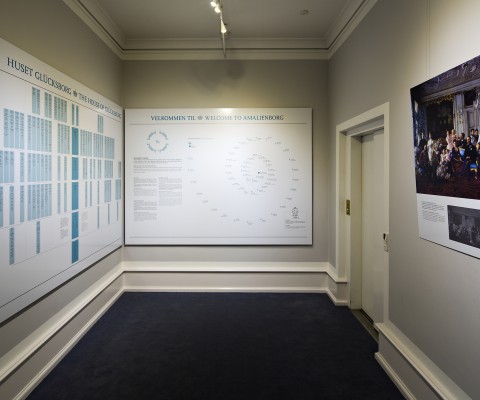
The Dynasty – The Genealogical table room

On the wall hangs a scaled down version of Laurits Tuxen’s enormous painting of Christian IX and Queen Louise together with their family. It was painted in 1882-6. The painting is displayed at Christiansborg Castle.

Christian IX was the first king of the Glücksburg Dynasty. Let us have a look at the reasons why he became king of Denmark. During the early part of the 19th century, the dynasty of the time, the Oldenburgs entered a crisis. After having been in possession of the Danish crown for 350 years, the dynasty was unable to produce a male heir.

Frederik VI only had two daughters so he was succeeded by Christian VIII, his half-cousin. Christian VIII had one son from his first marriage, the later King Frederik VII, who himself died childless after three marriages. He was the last Oldenburg king. In the meantime there were attempts to marry the two family lines together; the younger brother of Christian VIII, Ferdinand, was married to the oldest daughter of Frederik VI, Caroline and Frederik VII was married to the youngest daughter of Frederik VI, Vilhelmine. The last marriage only lasted for a couple of years – the temperaments were too incompatible. But the desired result didn’t materialise. There were no children and, therefore, no heirs to the throne.

It became necessary to find a new heir to the throne and in 1852 Christian (IX) was chosen. He was Prince of Holstein-Beck and Duke of Glücksburg. That may sound distant but Christian was actually a direct descendent of the Danish King Christian III so he also belonged to the Oldenburg line. Furthermore, through his mother he was a great grandchild of Frederik V and as such a nephew to Frederik VI’s Queen Marie. So the kinship was not as distant as it may sound.

In 1842 he was married to Louise of Hesse, whose mother was a sister to Christian VIII. She was therefore a niece of the king (and a cousin to Frederik VII) and also a great grandchild of Frederik V.

Christian IX and Louise had six children whom, as a result of a deliberate effort from Queen Louise, were married into the great princely houses of Europe. The older children were born before Christian (IX) became heir to the throne. There was strong cohesion within the family which was not particularly wealthy. This continued after the children grew up and led to friendly relations between many countries, which had a strong influence on the political circumstances in Europe in the years leading up to World War I.

The eldest child was Frederik (VIII), who in 1863 was married to Princess Lovisa of Sweden-Norway.

Then came Alexandra, who in 1863 was married to Edward (VII), Prince of Wales, later King of the United Kingdom.

Then followed Wilhelm, who in 1863 was elected King of Greece as George I. Married in 1867 to Olga, Grand Duchess of Russia and a niece to Emperor Alexander II of Russia.

Dagmar (Maria Feodorovna), married in 1866 to Alexander (III), later Russian Emperor.

Thyra, married in 1878 to Ernest Augustus, pretender to the Kingdom of Hanover and Duke of Cumberland.

Valdemar, married in 1885 to Marie d’Orléans, great grandchild of King Louis Philippe of France.

In this way solid dynastic bonds were created with several great European countries. It is noticable that the German Empire isn’t represented. The relations between Christian IX and Emperor Wilhelm II were cool. The Danish defeat in 1864, when Schleswig-Holstein came under Prussia and later the German Empire, was not forgotten. North Schleswig became part of Denmark after a referendum in 1920.

Thus, the large painting depicts the ”Parents-in-law of Europe”, as the couple sometimes was called, sitting in the garden hall at Fredensborg Castle, surrounded by their children, sons and daughters-in-law and grandchildren.

The family spread over most of Europe through marriage ties and there are descendants of Christian IX and Louise in the Danish, Norwegian, British, Belgian, Greek, Rumanian, Spanish, Bulgarian and Yugoslav royal families, in the family of the Grand Duke of Luxembourg and in the princely families Bourbon-Parma. Sayn-Wittgenstein-Berleburg, Schaumburg-Lippe, Torre e Tasso, Savoy-Aosta, Baden and Mecklenburg-Schwerin.

The complete genealogical tree of the Glücksburg family can be seen at the homepage of the Danish Monarchy.


Items in this Room

Click on th items to read more.

Christian IX and his family, 1886

The painting by Lauritz Tuxen of Christian IX and his family was made between the years 1883-6.

Comments

Please Note: At times Internet Explorer has problems showing comments. If so, please try with another browser.